Drone Spreading Solutions: How Precision Agriculture Is Changing Seed and Fertiliser Application
Not long ago, if you wanted to spread seed or fertiliser across a field, you had two real options: a tractor-drawn spinner or a contractor with a high-clearance spreader. Both work, but both come with constraints. Tractors compact the soil and can’t run when the ground is wet. Contractors cost a fixed price per hectare regardless of whether the whole field actually needs the same rate of input. That’s where drone spreading solutions have started to make a real difference in UK farming.
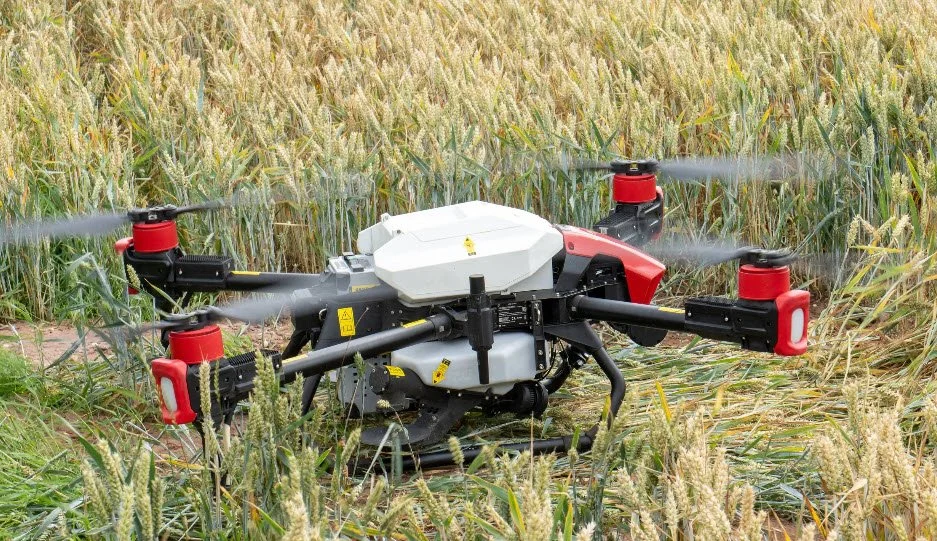
I’ve been working with agricultural drones for a few seasons now, and I’ve seen the shift from curiosity to genuine adoption. The early days were all about spraying: spot treatments, copper fungicide on small areas, that kind of thing. Spreading seed and granular fertiliser from the air felt like a stretch. The payloads were too small, the battery life too short, and the accuracy just wasn’t there. But the latest generation of hardware has changed that equation. Machines like the DJI Agras T50 and the XAG P100 Pro can carry 40 to 50 kilograms of material, fly for 10 to 15 minutes per load, and place seed or fertiliser with a consistency that rivals ground-based spreaders. That changes what’s practical.
What makes drone spreading solutions genuinely useful isn’t just the hardware, though. It’s the way they fit into a broader system of precision agriculture. When you combine variable rate application with GPS guidance and RTK positioning, you can treat each part of a field according to its actual need rather than a blanket average. Soil sampling tells you where the nutrient levels are low. LiDAR surveys show you the slope and drainage patterns. Then you build a prescription map and load it into the drone. The machine flies the pattern, adjusts the flow rate on the fly, and leaves a record of exactly what went where. That’s a level of control that a tractor with a spinner just can’t match.
One of the most practical uses I’ve seen is cover crop establishment. After harvest, the window for getting a cover crop in the ground is narrow, especially in the UK autumn when the weather turns wet. Driving a tractor across a field that’s already in stubble compacts the surface, damages the soil structure, and can delay emergence. A drone can fly the same field when it’s too wet to travel, spread the seed evenly, and finish the job in a fraction of the time. The seed broadcast from a drone is surprisingly uniform, especially if you use a spreader attachment that spins the seed outward rather than dropping it straight down. I’ve seen cover crop establishment rates that are every bit as good as a conventional drill, and sometimes better because the seed lands on the surface rather than being buried too deep.
Fertiliser application is another area where the technology proves itself. Top-dressing winter cereals with nitrogen, for example, is a task that usually involves a tractor on a wet field, which leaves ruts and compacts the soil. A drone can do the same job without touching the ground. The key is the accuracy of the spread pattern. The DJI Agras T50 uses a spinning disc that can throw granules up to six or seven metres, and with RTK positioning the overlap between passes is consistent. You can set the rate per hectare, and the drone will adjust its speed and flow to match. That’s precision agriculture in practice, not just a buzzword.
Of course, you can’t just buy a drone and start flying it over farmland. The regulatory side is real, and it’s something every operator has to deal with. In the UK, the Civil Aviation Authority sets the rules for commercial drone operations. For spreading tasks, you’re typically flying a machine that weighs over 25 kilograms, which means you need an operational authorisation from the CAA, a PfCO or similar permission, and a valid insurance policy. The HSE also has an interest, particularly if you’re handling chemicals like copper fungicide or certain liquid fertilisers. DEFRA sets the rules for what you can apply and how close to watercourses you can spread. BASIS and NRoSO qualifications are relevant if you’re giving agronomic advice or handling pesticides. It’s not a barrier, but it’s a set of hoops that any professional operator needs to jump through.
I’ve also seen a growing interest in using drone spreading solutions for slug pellet application. This is a contentious one. Slug pellets are expensive and the environmental impact is a concern if they’re spread too heavily or too close to water. Drone spreading allows for very precise placement, especially in fields where slug pressure varies. You can fly a LiDAR-derived map of the field, identify the wet patches where slugs are likely to be active, and apply the pellets only there. That saves money and reduces the environmental footprint. It’s a good example of how the technology supports sustainable farming rather than just replacing a tractor.
The Yamaha RMAX is worth mentioning here because it was one of the first practical agricultural drones, long before the Chinese manufacturers entered the market. It’s a helicopter-style machine, not a multi-rotor, and it’s still in use for some specialist applications. But the newer multi-rotors like the T50 and the P100 Pro are much easier to operate, cheaper to maintain, and carry a better payload-to-weight ratio. The RMAX has a place in history, but it’s not the future of the sector.
When I talk to farmers about adopting drone spreading, the questions that come up most often are about yield. Does it actually improve yield? The honest answer is: it depends. If you’re replacing a conventional spreader with a drone on the same field with the same rate, the yield difference is usually small. The real gains come from the combination of precision and timeliness. Being able to spread nitrogen when the crop needs it, not when the ground is dry enough to travel. Being able to establish a cover crop the day after harvest rather than waiting a week for the weather to break. Being able to apply variable rates that correct for soil variability. Those are the things that move the yield needle, and they’re exactly what drone spreading solutions enable.
I’ll give you a concrete example from last season. A farm in East Anglia had a field of winter wheat where the north end is a sandy loam and the south end is heavy clay. The soil sampling showed the clay side needed an extra 30 kilograms of nitrogen per hectare compared to the loam. With a conventional spreader, you’d have to apply the same rate across the whole field, over-feeding the loam and under-feeding the clay. With a drone and variable rate application, you can create two zones, adjust the rate on the fly, and the yield map at harvest shows the difference. The clay end performed as well as the loam end, and the overall yield was higher than it would have been with a flat rate. That’s the kind of result that gets people interested.
One thing I’d caution against is the idea that a drone can replace every piece of kit on the farm. It can’t. For large-scale bulk spreading, a tractor-drawn spreader is still faster and cheaper per tonne. But for precision work, for difficult-to-reach areas, for wet conditions, and for small to medium-sized fields, drone spreading solutions offer a flexibility that ground-based equipment can’t match. The sweet spot is where accuracy and timeliness matter more than raw throughput.
The technology is still evolving. Battery life is improving, payload capacities are creeping up, and the software for creating prescription maps is getting easier to use. If you’re considering it, the best advice I can give is to start with a small project, maybe a few hectares of cover crop or a variable rate fertiliser trial, and measure the result against your usual method. That way you build experience without over-committing. And talk to someone who holds the relevant certifications, because the regulatory side is not something you want to guess at.